.png)
How does a twisted comedy so perfectly in line with the 2000s’ crude humour, nearly Total Drama-stupid laughs galore, fail renewal? By competing with It’s Always Sunny in Philadelphia. That was all it took to knock down the teetering scaffold composing Starved, FX’s beloved forgotten masterwork.
The show holds up here and doesn’t so much there. Sitcoms survive on character, and Sam (Eric Schaeffer, also the director) is a disdainfully delightful crash-and-burn loser. Much remains to be said on the choice of a male lead when anorexia so stubbornly, viciously affects almost exclusively women and girls, but that’s sort of the point: it’s Freudian funny to watch a man so homosexually obsessed with his appearance fall for women over and over. Stands to reason that Billie (Laura Benanti) isn’t the only one.
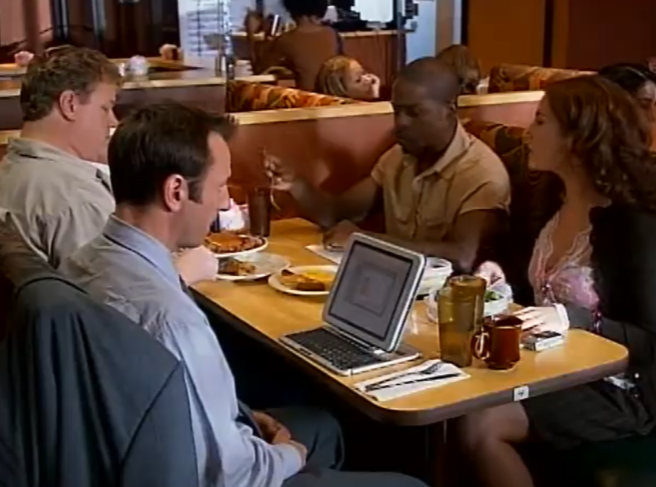
It isn’t discussed anywhere, but up for grabs like a low-hanging peach is the understanding that Belt Tighteners, the not-so-supportive support group our disordered leads attend, is a real-life replica of eating disorder forums. This is what adult illness looks like, says Starved; the hardship follows you everywhere. You don’t have an online escape. It’s that very dark messaging that converts to comedy at the best of times: the receptionist handing Sam his locked-drawer muffin collection, or Dan’s (Del Pentecost) preference for food over sex with his wife, or a homeless man catching cop Adam (Sterling K. Brown) purging in public on the damn job. That these disorders are inflicted on the general public flips the “suffering in silence” narrative clean on its head. And it’s true that the anorexic person is rarely the only one affected despite how lonely sufferers may feel. It’s the family fruitlessly talking them out of it, unsuspecting bathroom-goers overhearing the carnage, the friendly bakery cashier who greets you each week, that lie awake worrying.
Realism weaves between the ridiculousness at the most unexpectedly necessary of moments. A friend group founded on shared mental illness is wont to be toxic here and there, after all — Sam and Billie dance around a one-sided romance, Adam agonizes alone, Dan destroys the sole relationship that’s halfway functional in his life, and when they concur bubbles the cauldron. No “ana buddy” group chat, they warn, can substitute a meaningful relationship, a rich inner life.
Is Starved a scare tactic? Quite so, but not for the disordered. The general public that finds it so uncomfortable deserves this unconcealed inner world, less so they know its secrets than to reflect on their own contributions. Each character’s history is peppered throughout, refusing to bristle at the pushback traumatizers are so typically armed with — Billie, with her abusive parents and a ballet-dancer past, is a prime example. Her married gay fathers view the very problems that torment her as one big attention-seeking farce. She can’t escape male attention as the sole woman in her friend group. Her most intimate relationships are spiteful and sexual in nature. The “only girl” trope is a recurrent media staple, but seldom does its employment address what prize-ification, patriarchy, abuse do to the girl in question.

Real-life parents of anorexic children are united by the same painful journey: agonizing, coping, denying, pleading; blaming themselves, blaming others, blaming the world. Without direct confrontation — a notorious weak point among the eating-disordered —, loved ones simply can’t wrap their heads around their own role in another’s self-destruction. Starved may have been a burnt-black comedy, and it may have heaped on the vulgarity too strongly, but it was a pioneer in bridging that gap.
.png)

.png)

.png)
